


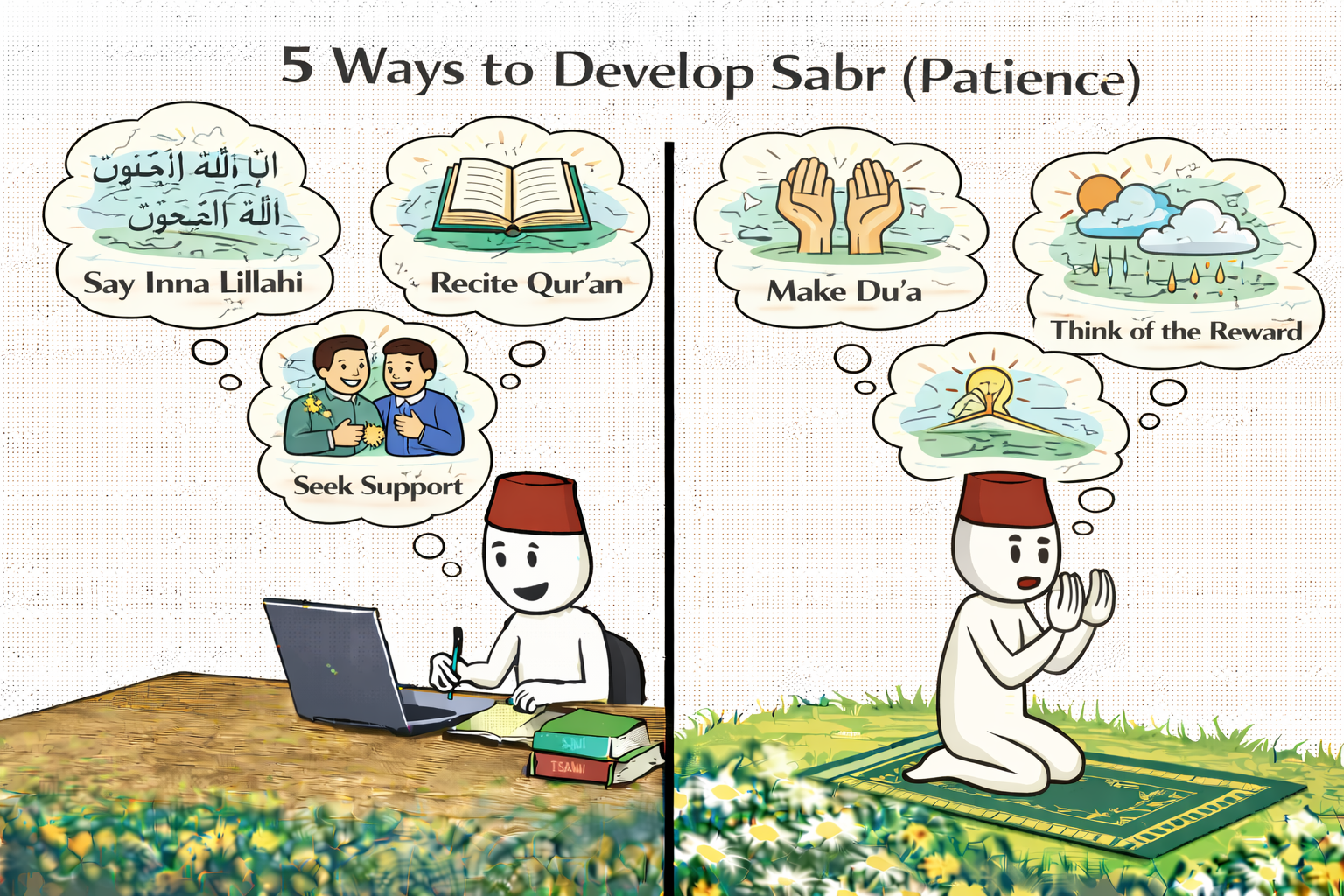

5 Ways to Develop Sabr (Patience)
Life is full of tests — some small, some overwhelming. In every situation, Islam teaches us one powerful quality that helps us navigate both ease and hardship: sabr (patience).
Sabr is not simply waiting or remaining silent in difficulty. It is the strength to stay firm upon what is right, to control our reactions, and to trust Allah even when things do not go as we planned.
“Indeed, Allah is with the patient.”
(Surah Al-Baqarah, Verse 153)
Developing sabr is a gradual process that requires awareness, effort, and faith. Here are five ways to build patience in your daily life.
1. Strengthen Your Relationship with Allah
Patience becomes easier when the heart is connected to Allah.
When we truly believe that Allah is All-Wise and All-Knowing, we begin to trust that every situation has a purpose — even if we do not understand it immediately.
Through regular prayer, dhikr, and recitation of the Qur’an, we strengthen our faith and develop inner stability.
The stronger our connection with Allah, the more patient we become in facing life’s challenges.
2. Understand That Life Is a Test
One of the key foundations of sabr is recognizing that this life is meant to test us.
Allah says that we will be tested with fear, loss, and hardship.
When we accept this reality, we stop asking “Why is this happening to me?” and start asking “How should I respond in a way that pleases Allah?”
This shift in mindset transforms difficulty into an opportunity for growth.
3. Control Your Immediate Reactions
Sabr is often tested in the first moment of hardship.
The Prophet ﷺ said:
“Patience is at the first strike of calamity.”
(Sahih al-Bukhari)
How we react initially determines the strength of our patience.
Instead of reacting with anger, frustration, or despair:
- Pause
- Take a deep breath
- Remember Allah
This brief moment of control can prevent regret and help maintain composure.
4. Keep Perspective of the Hereafter
One of the most powerful ways to develop patience is to remember that this life is temporary.
Every hardship we face is temporary, but the reward for patience is eternal.
“Indeed, the patient will be given their reward without account.”
(Surah Az-Zumar, Verse 10)
When we focus on the Hereafter, our current struggles feel lighter, and we become more willing to endure them with patience.
5. Make Du’a for Patience
Patience is not something we develop on our own — it is a gift from Allah.
Turning to Allah and asking for sabr is one of the most effective ways to strengthen it.
The Qur’an teaches us the du’a:
“Our Lord, pour upon us patience…”
(Surah Al-Baqarah, Verse 250)
Regularly asking Allah for patience brings strength to the heart and helps us face challenges with calmness and trust.
Final Reflection
Sabr is not about being emotionless — it is about responding to life’s challenges with faith, control, and trust in Allah.
By strengthening our connection with Allah, understanding the nature of tests, controlling our reactions, focusing on the Hereafter, and making du’a, we can gradually develop true patience.
Every moment of patience is seen and rewarded by Allah, even if it goes unnoticed by others.
May Allah grant us sabr in all situations, strengthen our hearts, and reward us for every hardship we endure with patience. 🤲✨