


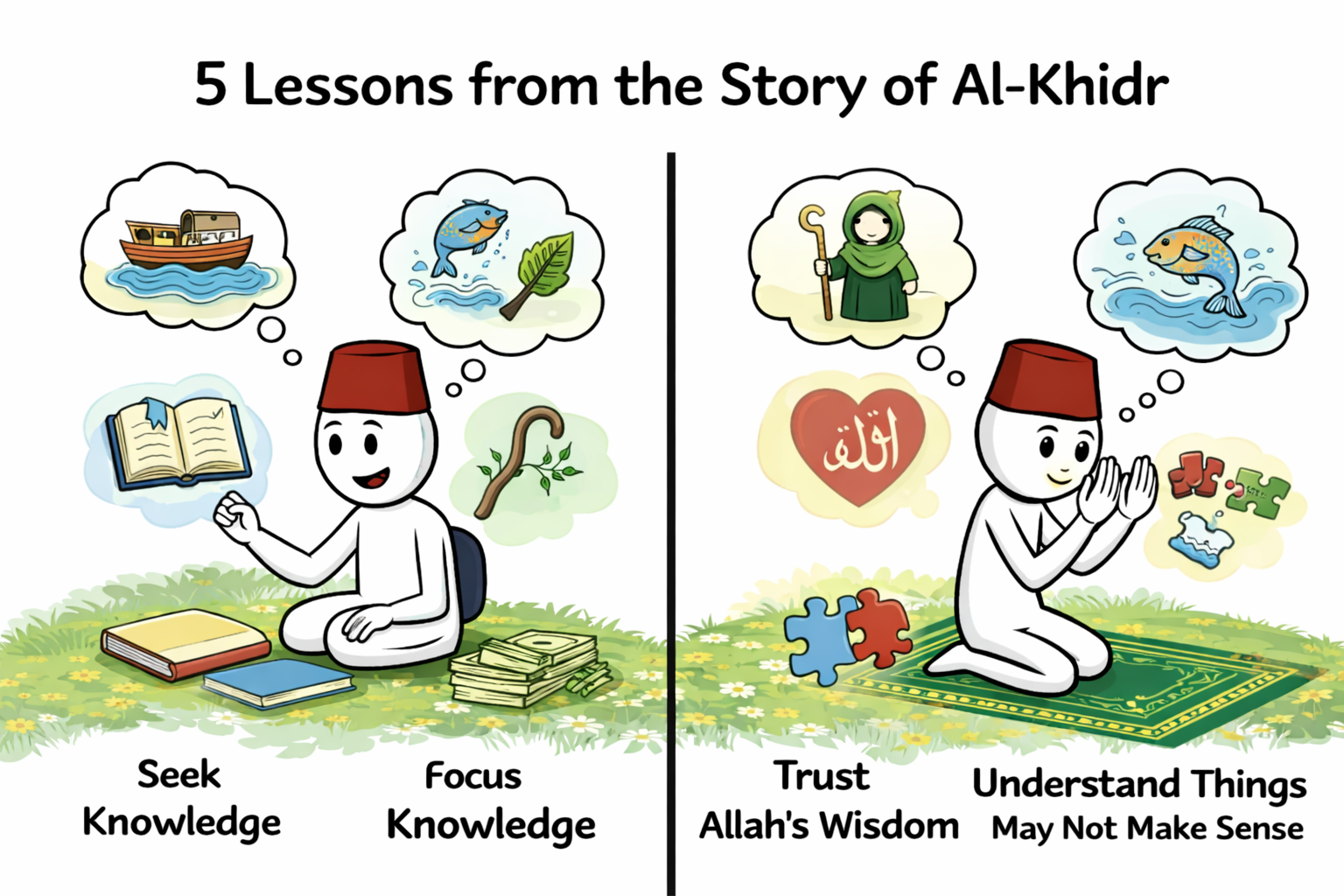

The story of Al-Khidr and Prophet Musa (AS) is one of the most profound and thought-provoking narratives in the Qur’an. It challenges how we understand events, teaches us humility in knowledge, and reminds us that Allah’s wisdom often lies beyond what we can immediately comprehend.
When Musa (AS), a great prophet, set out to learn from Al-Khidr, he encountered actions that seemed confusing and even troubling. Yet, by the end of the journey, each action revealed a deeper wisdom that was hidden at first.
“And how can you have patience for what you do not encompass in knowledge?”
(Surah Al-Kahf, Verse 68)
This story is not just about knowledge — it is about trust, patience, and accepting that not everything will make sense right away.
Here are five powerful lessons we can learn from the story of Al-Khidr.
1. Allah’s Wisdom Is Greater Than Our Understanding
One of the most important lessons from this story is that Allah’s plan is always perfect, even when we do not understand it.
The actions of Al-Khidr — damaging the boat, taking the life of a boy, and repairing a wall without payment — all seemed wrong at first.
But later, their wisdom became clear:
- The boat was saved from being seized
- The child was replaced with someone better
- The treasure beneath the wall was protected
This teaches us that:
- Not everything that seems bad is truly bad
- Not everything that seems good is truly good
- Allah sees what we cannot
When things don’t make sense, trust that there is wisdom behind them.
2. Patience Requires Trust in the Unseen
Musa (AS) struggled to remain patient because he could not see the full picture.
Al-Khidr reminded him that patience is difficult when knowledge is incomplete.
This applies to our lives as well.
We often become impatient because:
- We don’t know the outcome
- We don’t understand the reason
- We want immediate answers
But true patience means trusting Allah even without full understanding.
It is about remaining steady while waiting for clarity.
3. Humility in Knowledge Is Essential
Despite being a prophet, Musa (AS) was sent to learn from Al-Khidr.
This shows that no matter how much knowledge a person has, there is always more to learn.
It teaches us:
- Never assume you know everything
- Stay open to learning from others
- Recognize the limits of your understanding
Knowledge should make a person humble, not arrogant.
The more you learn, the more you realize how much you don’t know.
4. Not Everything Needs Immediate Explanation
Musa (AS) questioned Al-Khidr’s actions immediately, but he was told to be patient.
In life, we often want instant answers.
We ask:
- Why is this happening?
- Why now?
- Why me?
But sometimes, the answer is not immediate.
This story teaches us that:
- Some things take time to understand
- Some answers are revealed later
- Some wisdom may remain hidden
Learning to accept uncertainty is part of faith.
5. What You Lose May Be for Your Good
Each event in the story involved some form of loss or difficulty.
But in reality, each one was a form of protection or preparation for something better.
This teaches us that:
- Loss is not always harmful
- Difficulty can be a form of mercy
- What is taken away may be replaced with something greater
Sometimes, what we think is a setback is actually a step forward.
Final Reflection
The story of Al-Khidr teaches us to trust Allah deeply, remain patient in uncertainty, and stay humble in our understanding.
It reminds us that life is not always meant to make sense immediately — and that is part of the test.
When things feel confusing or difficult, remember that Allah’s wisdom is always working, even when you cannot see it.
Every situation, no matter how unclear, is part of a greater plan.
May Allah grant us patience in times of uncertainty, humility in knowledge, and complete trust in His wisdom and plan. 🤲✨