


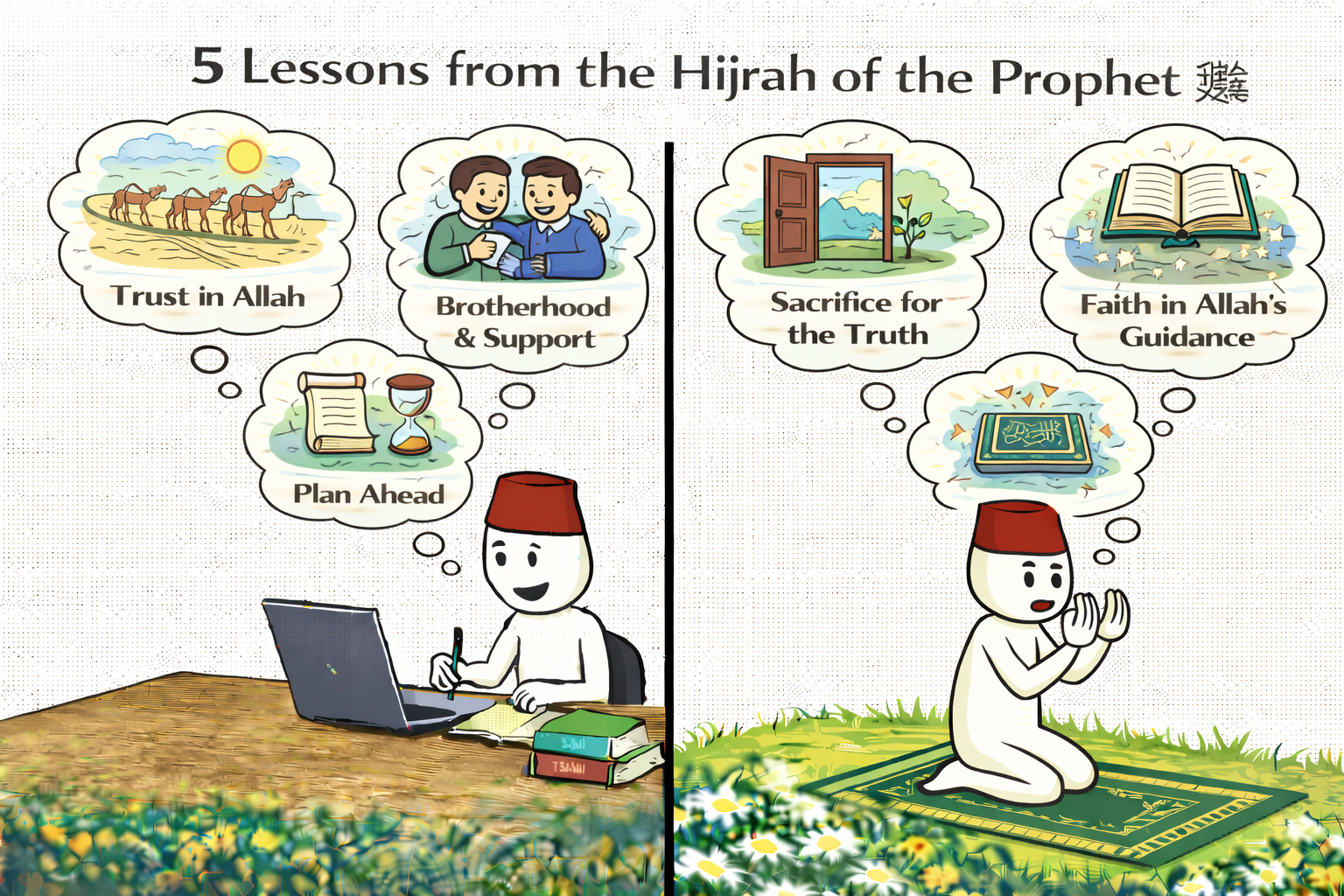

5 Lessons from the Hijrah of the Prophet ﷺ
The Hijrah of the Prophet ﷺ — his migration from Makkah to Madinah — is one of the most powerful and transformative events in Islamic history. It was not merely a physical journey, but a journey of faith, sacrifice, and complete reliance on Allah.
At a time when the Prophet ﷺ and his companions faced severe persecution, the Hijrah marked the beginning of a new chapter — one of hope, strength, and the establishment of a just and faithful community.
“Indeed, those who have believed and those who have emigrated and striven in the cause of Allah — those expect the mercy of Allah…”
(Surah Al-Baqarah, Verse 218)
Here are five important lessons we can learn from the Hijrah of the Prophet ﷺ.
1. Trust in Allah During Uncertainty
The journey of Hijrah was filled with danger and uncertainty. The Prophet ﷺ and Abu Bakr As-Siddiq were being pursued, and their lives were at risk.
While hiding in the cave, when fear could have taken over, the Prophet ﷺ reassured his companion:
“Do not be sad. Indeed, Allah is with us.”
(Surah At-Tawbah, Verse 40)
This moment teaches us that even in the most uncertain situations, placing trust in Allah brings peace and strength.
2. Take Action Alongside Tawakkul
Although the Prophet ﷺ had complete trust in Allah, he also took every possible step to ensure safety during the journey.
He planned carefully, chose a less obvious route, and arranged for support along the way.
This shows that tawakkul is not about passivity — it is about combining effort with reliance on Allah.
We are taught to plan, act, and strive, while leaving the outcome to Allah.
3. Sacrifice for the Sake of Faith
The companions who migrated left behind their homes, wealth, and families for the sake of Allah.
Hijrah teaches us that sometimes, we must let go of what we love for something greater.
True faith requires sacrifice — whether it is giving up bad habits, leaving harmful environments, or prioritizing deen over dunya.
The reward for such sacrifices is always greater than what is left behind.
4. The Importance of Good Companionship
The companionship of Abu Bakr As-Siddiq during the Hijrah highlights the importance of having righteous company.
He stood by the Prophet ﷺ with loyalty, courage, and unwavering support.
This teaches us that the people we surround ourselves with play a crucial role in our journey of faith.
Good companions encourage us, support us in difficult times, and help us stay on the right path.
5. Every Difficulty Leads to Ease
The Hijrah began with hardship, fear, and loss — but it ended with stability, growth, and the establishment of a strong Muslim community in Madinah.
This reminds us that hardship is often followed by ease and that every challenge carries hidden blessings.
“Indeed, with hardship comes ease.”
(Surah Ash-Sharh, Verse 6)
No matter how difficult a situation may seem, relief is always near for those who remain patient and trust in Allah.
Final Reflection
The Hijrah of the Prophet ﷺ is more than a historical event — it is a timeless lesson in faith, courage, patience, and trust.
It teaches us to rely on Allah in uncertainty, take action with wisdom, sacrifice for what truly matters, value righteous companionship, and remain hopeful through hardship.
Every believer has their own form of Hijrah — a journey of moving away from sin and towards obedience to Allah.
May Allah grant us the strength to make our own Hijrah in life, purify our intentions, and guide us on the path that leads to His pleasure. 🤲✨